
Control how Google understands your content and measures your authority.
Entity SEO and internal linking, built for publishers
Google runs its own language analysis on every page it indexes, but it misses about a third of your topics. TopicalBoost checks that work, adding the topics Google missed and blocking the ones it gets wrong. It then uses those topics to create internal links that route authority from your archive to your latest coverage.
More organic traffic and more placements in Top Stories, Google Discover, and News—without changing a word your team writes.
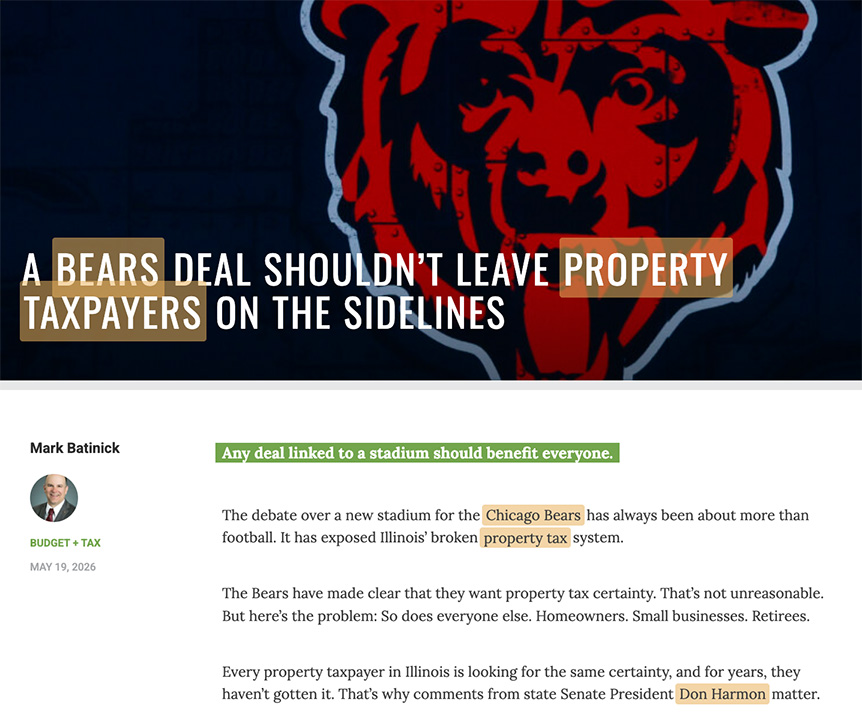
football team”
“@id”: “kg:/g/01y3v”
wikidata.org/Q205033
in the United States” “description”: “Tax on
real estate in the U.S.”
“@id”: “kg:/g/0dlj_6r”
wikidata.org/Q7250248
“@id”: “kg:/g/02qgtkw”
wikidata.org/Q5292744
As featured on

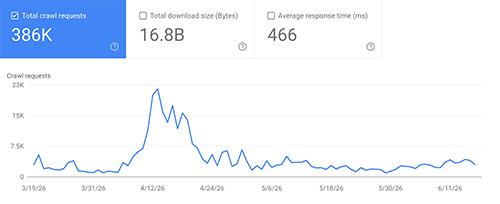
Search Engine Land activated TopicalBoost in March. Over the next 13 weeks, editorial SEO publishers lost 30% of their traffic on average. Search Engine Land grew 13%. AI Overview citations more than doubled.
Trusted by editorial teams at












Most SEO software wasn’t built for publishers.
If you’ve bought keyword tools or page-optimization apps like Clearscope or Surfer, you’ve probably watched them go unused. Most SEO software is built for local businesses and e-commerce, sites with fixed targets and keywords they know will drive sales.
Publishers don’t work that way. You’re not writing to win a keyword, you’re trying to cover live, fast-moving stories. Keyword-first tools don’t help you when you’re reacting to real-world events and the target is always moving.
Fundamentally these tools are built to do one thing: tell you what to write. But your writers and editors are never going to take writing advice from a spreadsheet. Instead of writing to fit the search engine, you need a tool to fit the search engine to your writing.
You need entity infrastructure.
The BBC, Reuters, and AP figured this out years ago—they know that Google measures authority around topics, so they spent millions on proprietary taxonomy systems to organize their content libraries around the people, places, and concepts they cover. TopicalBoost gives you the same infrastructure, but uses Google’s own Knowledge Graph as a fixed vocabulary for that taxonomy.
And while other entity tools stop at simply adding markup Google already generates on its own, TopicalBoost goes further. It checks Google’s read of your content, adds the topics it missed, and blocks the ones it gets wrong. So you’re not repeating Google’s markup of your site—you’re correcting it.
Topic hubs are then built both to route authority from your archive to your latest posts and to show the depth of coverage.
Site-wide technical SEO fixes help Google crawl your site. TopicalBoost is the site-wide fix that helps Google understand it.

Correct how Google indexes your content.
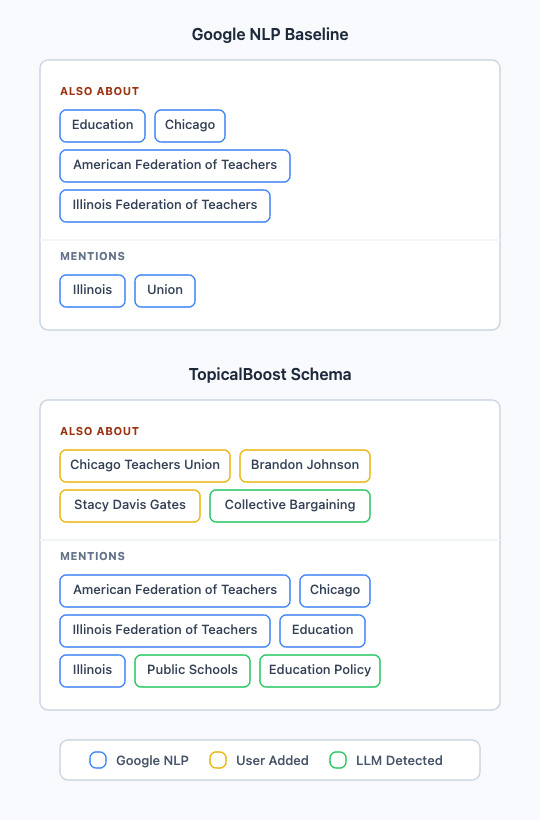
Google runs language analysis on every page it indexes—and it misses a lot. TopicalBoost corrects that record by first using Google’s own Natural Language Processing (NLP) and then by re-analyzing each post using AI to catch what Google misses.
In this real-world example, Google’s NLP analyzed a story about a Chicago teachers’ fight without catching the Chicago Teachers Union, the mayor, or the union’s president. TopicalBoost let users add those topics, and our AI analysis added topics like collective bargaining, education policy, and public schools.
This gives Google, other search engines, and AI agents a much more complete understanding of the article.
As of July 2026, Google’s NLP has identified 4.95 million topic connections across all TopicalBoost subscribers. Our AI layer added another 2.57 million, representing roughly a third of all topics.
Check and fix any post by hand.
As you write and edit each draft, TopicalBoost will show you what Google’s NLP read and lets you fix it. Reclassify an entity, promote it to Main Topic, or correct a mislabel. You can even manually add a topic through a quick Knowledge Graph query.

Add the topics you cover most.
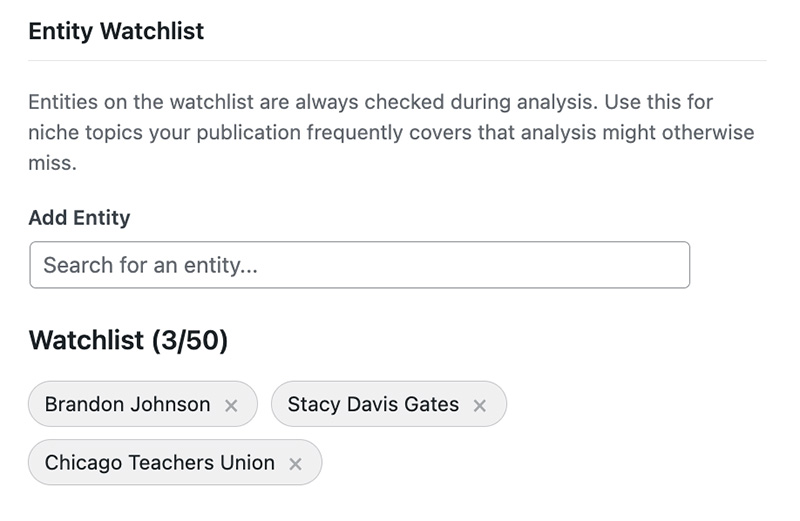
Google’s NLP often misses the entities your publication covers most—the local officials, agencies, and bills you name constantly. Add them to your watchlist once, and TopicalBoost tells its AI layer to look for them in every post.
The watchlist can be updated on the settings page, or new topics can be added right from the post editor. Manually add a topic once, then set TopicalBoost to find it automatically going forward.
Hide what doesn’t belong—site-wide.
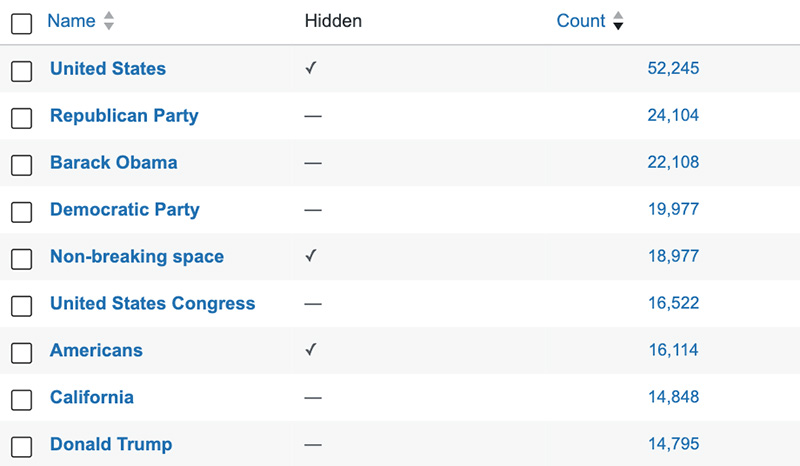
The site-wide topic list shows every entity detected across your archive. Hide a name, a brand, or an off-mission concept with one click, and it never shows up again, even if it’s detected in future articles.
Schema and internal linking, built automatically.
When you hit publish, TopicalBoost builds the infrastructure behind the scenes.
Route your authority.
Most publisher archives have lots of backlinks, but they’re scattered across thousands of individual articles. Those articles may link to broad category pages, but people seldom search for terms like “Politics” or “Technology.”
TopicalBoost links entities mentioned in your articles to dedicated topic pages that focus on a person, organization, product, policy, or concept. This turns scattered link equity into concentrated authority, topic by topic.



A shortcode or a single line of PHP integrates topics into your frontend.
Schema written into your pages, where AI can read it.
Every entity you confirm becomes schema.org data, written straight into your page’s HTML and tied to Google’s Knowledge Graph.
That matters more than ever. Most AI crawlers (GPTBot, ClaudeBot, PerplexityBot, and the rest) don’t run JavaScript; they only read the HTML. Schema added by a script is invisible to them. TopicalBoost’s is native to your pages, so Google and the AI engines both read it on every visit. (Vercel: AI crawlers don’t render JavaScript)
{
  "@context": "https://schema.org",
  "@type": "Article",
  "mainEntity": {
    "@type": ["Thing", "Organization"],
    "@id": "kg:/g/07t65",
    "name": "United Nations",
    "url": "https://www.un.org/",
    "sameAs": [
      "https://wikidata.org/wiki/Q1065",
      "https://twitter.com/UN"
    ],
    "location": {
      "@type": "Country",
      "name": "United States"
    }
  }
}Help each post win in search.
Corrected topics are the foundation. These two tools turn them into clicks.
Stop guessing at keywords.
TopicalBoost simplifies the confusing world of keyword research into a number and a color. Each topic shows the monthly traffic you could expect if you ranked #1 for that term, and the difficulty to rank for that term is expressed in colors ranging from red to green. No more guessing at keywords or opening third-party tools. Make the call in the CMS as you’re editing.

Color = how hard the topic is to rank for.
Ship titles and descriptions that include your focus topic.
TopicalBoost will generate title tags and meta descriptions that incorporate your focus topic. Editors select what fits best and can tweak as needed. This makes SEO best practices a baked-in part of your process, rather than rules to remember.
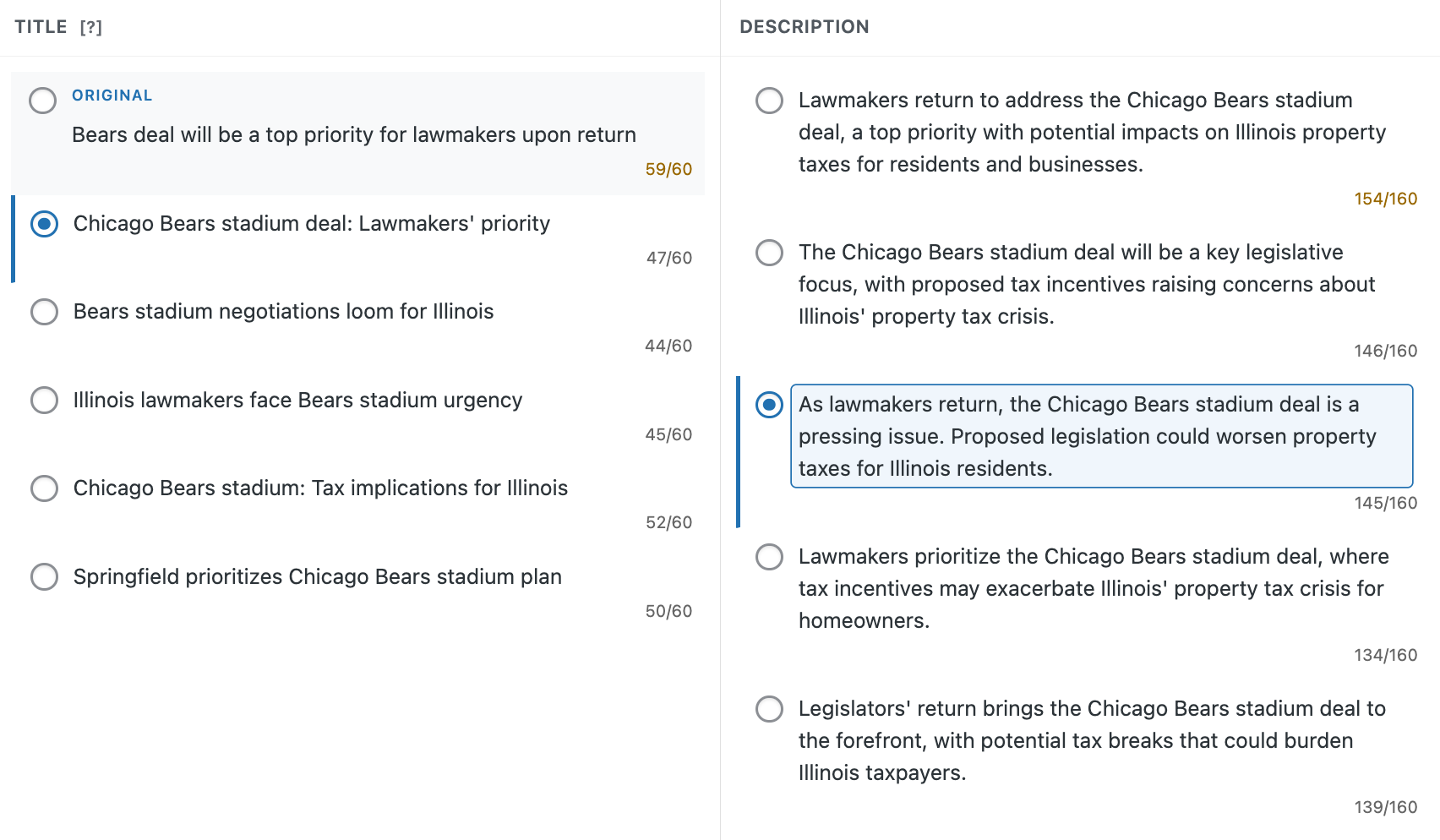
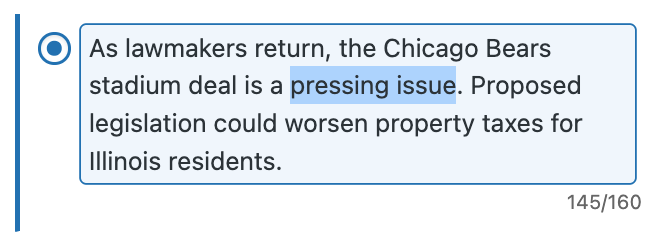
Titles and meta description stay under Google’s character limits.
Analyze your entire archive.
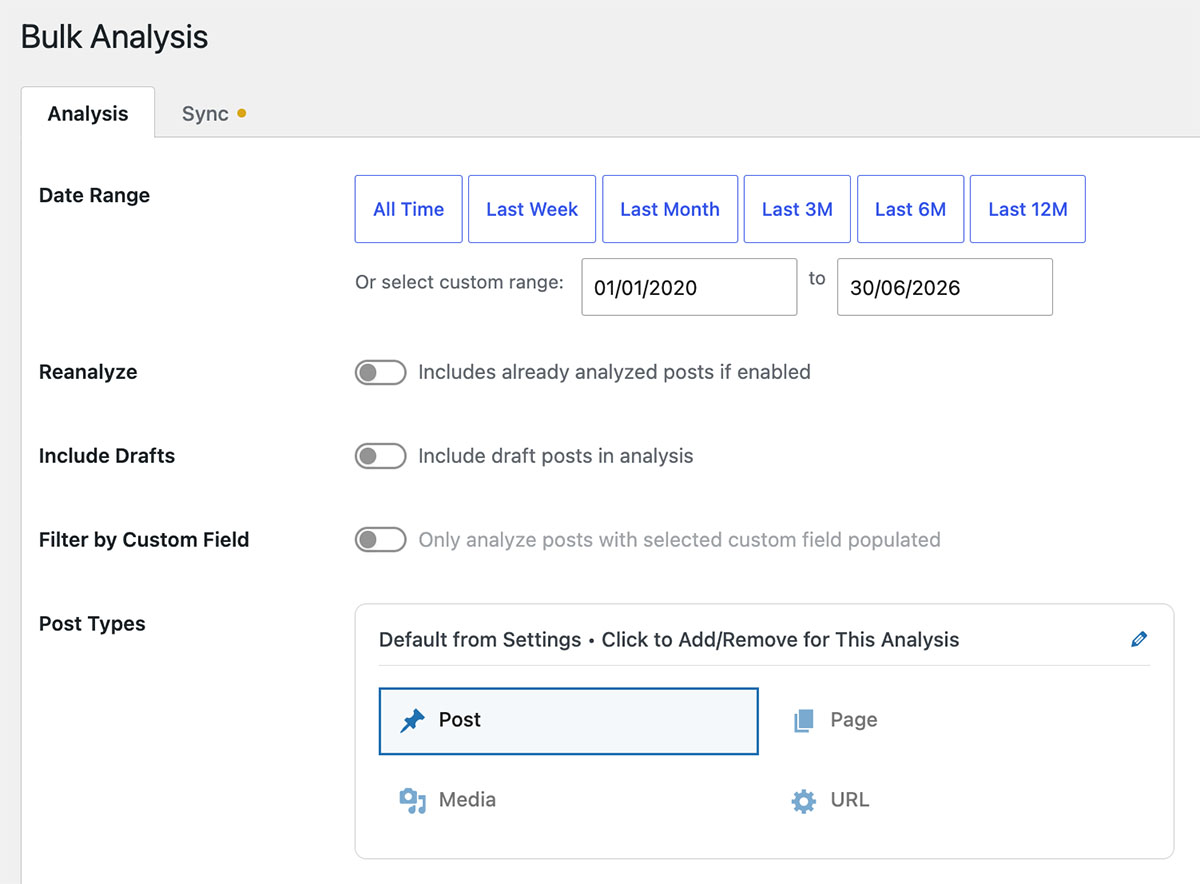
TopicalBoost runs its full NLP-and-AI analysis on every post you’ve ever published—5,000, 50,000, or 500,000. Not a sample. Not a paywalled subset. Pick a date range or your whole history, choose your post types, and analyze it all. No per-page credits, no extra fees.
In a few hours—or a few days for the largest sites—TopicalBoost reshapes your entire site without changing a word of your content. Clients routinely see Google re-crawl the whole archive within days.
Built for any stack
WordPress
Native plugin
Drupal
Native module
Custom API
Direct API integration
Elevate your entire publication.
Stop fighting for traffic one article at a time.
Illinois Policy saw organic search traffic grow 62% in the first 60 days of using TopicalBoost. That growth held at 37% over six months, moving from an average of 935K to 1.28M monthly sessions. Google Discover clicks tripled from 49K → 154K, hitting 244,000 in December 2025. Average search position moved from 10.5 to 7.0. Top-3 positions increased by 26%.
Carolina Journal activated TopicalBoost in September 2025. In the six months after launch, they earned 106 Top Stories appearances across 83 unique pages—up from 22 appearances in the six months before. 71 of those 106 appearances landed at position 1 or 2 in the carousel.
Just before Washington state’s budget battle heated up, Washington Policy Center connected their custom CMS to the TopicalBoost API. They went from near-zero Google Discover traffic to over 22,500 Discover clicks in the first 90 days—including a 9,714-click single-day high on a property-tax article eleven days after launch.
After installing TopicalBoost, Reason magazine’s Google Discover traffic nearly quadrupled, reaching over 225,000 clicks a month. The publication also saw its largest-ever Google News day—over 40,000 clicks—after launching TopicalBoost.
Before TopicalBoost, FDD had essentially no Google News traffic and modest Google Discover traffic. In the first 8 months after launching, Discover traffic grew over 1,000% and Google News went from barely noticeable to over 100,000 clicks.
Ready to put TopicalBoost to work on your archive?
Get featured alongside Reuters, CNN, and The New York Times.
By clustering content around entities in Google’s Knowledge Graph, TopicalBoost helps our customers earn Top Stories placements alongside national and regional news brands.

illinoispolicy.org
“bears new stadium”
7k monthly searches · sustained 5 hours
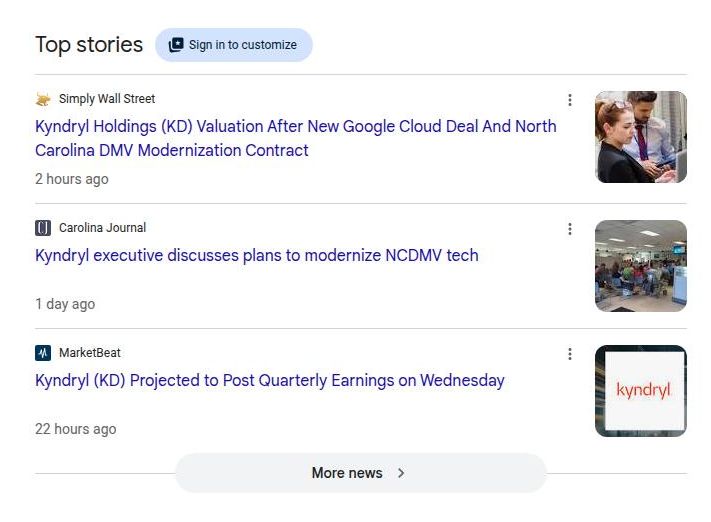
carolinajournal.com
“kyndryl”
23k monthly searches · sustained 18 hours

insideinvestigator.org
“marijuana”
147k monthly searches · sustained 3 hours

foreignpolicy.com
“israel war”
1.4M monthly searches · sustained 4 hours

washingtonpolicy.org
“seattle public schools”
15k monthly searches · sustained 3 days 8 hours

fdd.org
“hamas”
247k monthly searches · sustained 33 minutes

reason.com
“supreme court”
403k monthly searches · sustained 2 hours

city-journal.org
“bernie sanders”
949k monthly searches · sustained 27 hours

goodauthority.org
“india pakistan news”
18k monthly searches · sustained 47 hours

Prove your impact in Top Stories.
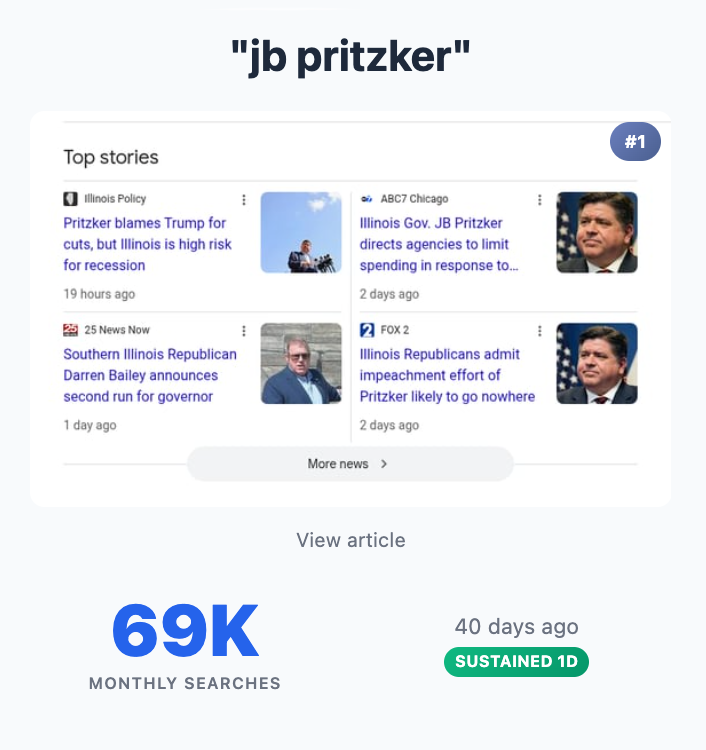
Your team already tracks media mentions. Search Clippings does the same for Google Top Stories. You see when you captured a news cycle, which competitors you ranked alongside, and how long you held the top spot.
Pricing for publishers
No contracts. No hidden costs.
Get started risk-free with our 60-day money-back guarantee.
All plans include:
Free training and onboarding
Every customer gets free, live training and onboarding.
Unlimited archive analysis
Analyze and assign topics to your entire back catalogue regardless of your plan.
Complete data retention
Your data is stored in your CMS and is yours forever. You only pay for ongoing analysis.
Quality support
If you’re a customer, we’re here to help. Quality support is not an upsell.
Every feature
There are no add-on tiers. Every feature is included in every plan.
Continuous updates
We’re always evolving. Enjoy ongoing updates to the plugin and API as we improve.

Book a demo.
Spend 45 minutes with Cord Blomquist, founder of TopicalBoost. You’ll see the in-editor experience inside your CMS, walk through how we connect your archive to Google’s Knowledge Graph, and explore the editorial controls that make rolling out TopicalBoost and managing your topics straightforward. Best attended by SEO leads. Audience and editorial leads welcome too.
Common questions
How is TopicalBoost different from Yoast or RankMath?
We don’t replace them. We extend them. Yoast and RankMath handle on-page SEO basics like title tags, sitemaps, and redirects. TopicalBoost adds the entity-level structured data they don’t: every article gets connected to Google’s Knowledge Graph, and your archive’s authority gets routed to your newest coverage. Search Engine Land runs both Yoast and TopicalBoost on the same site.
Does TopicalBoost use AI to generate content?
No. TopicalBoost uses Natural Language Processing to read what your editors wrote—to identify the people, places, and concepts already in the draft. We don’t generate article copy, summaries, or rewrites. AI does suggest five title-tag and meta-description options for each post, but editors choose and edit before publishing. Your content stays human-written.
Will TopicalBoost slow down my site?
No. Analysis runs on our infrastructure, not yours. The plugin makes one API call when a post is saved and writes structured data into the page head. No frontend JavaScript, no third-party trackers, no Core Web Vitals impact.
What does setup actually look like?
For WordPress and Drupal: install the plugin, paste an API key, run a one-time bulk analysis. That analysis will process every post you’ve ever published and writes structured data across your site. Editors don’t need to change their workflow—TopicalBoost lives inside the existing editor as a panel below the post body. End-to-end setup is typically a call that lasts less than an hour with a member of our team.
What if we already have a taxonomy team?
TopicalBoost works underneath your existing taxonomy, not in place of it. Your team’s manual tags stay where they are. We add the machine-readable entity layer Google needs. Each entity connects to a matching Knowledge Graph entry. Most of our customers use both: taxonomy for editorial navigation, TopicalBoost for search and Discover signals.
Do you support more than WordPress & Drupal?
WordPress and Drupal have native plugins maintained by our team. Craft CMS is supported through our partner Good Work. For custom and headless setups, we offer a REST API.